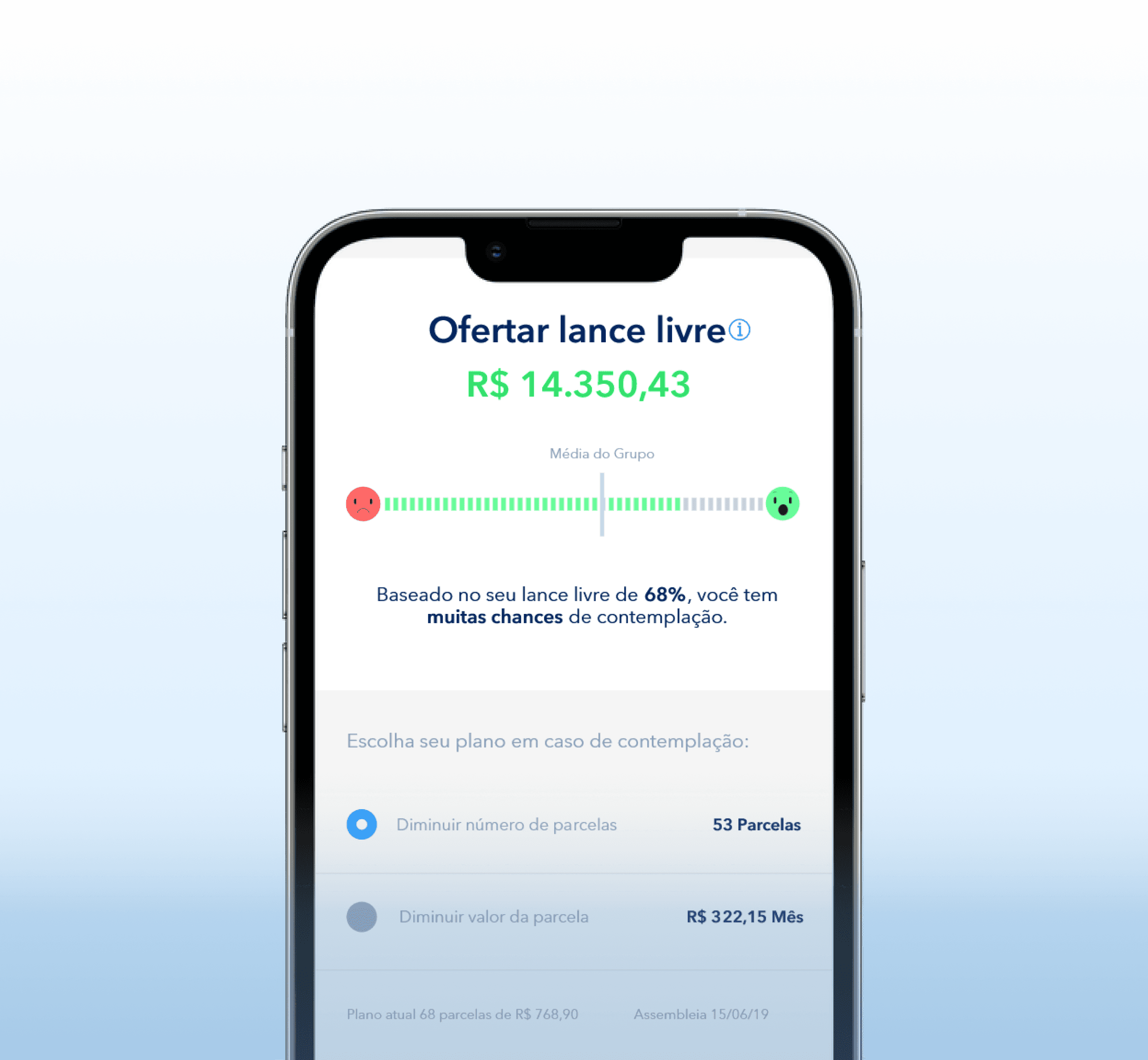
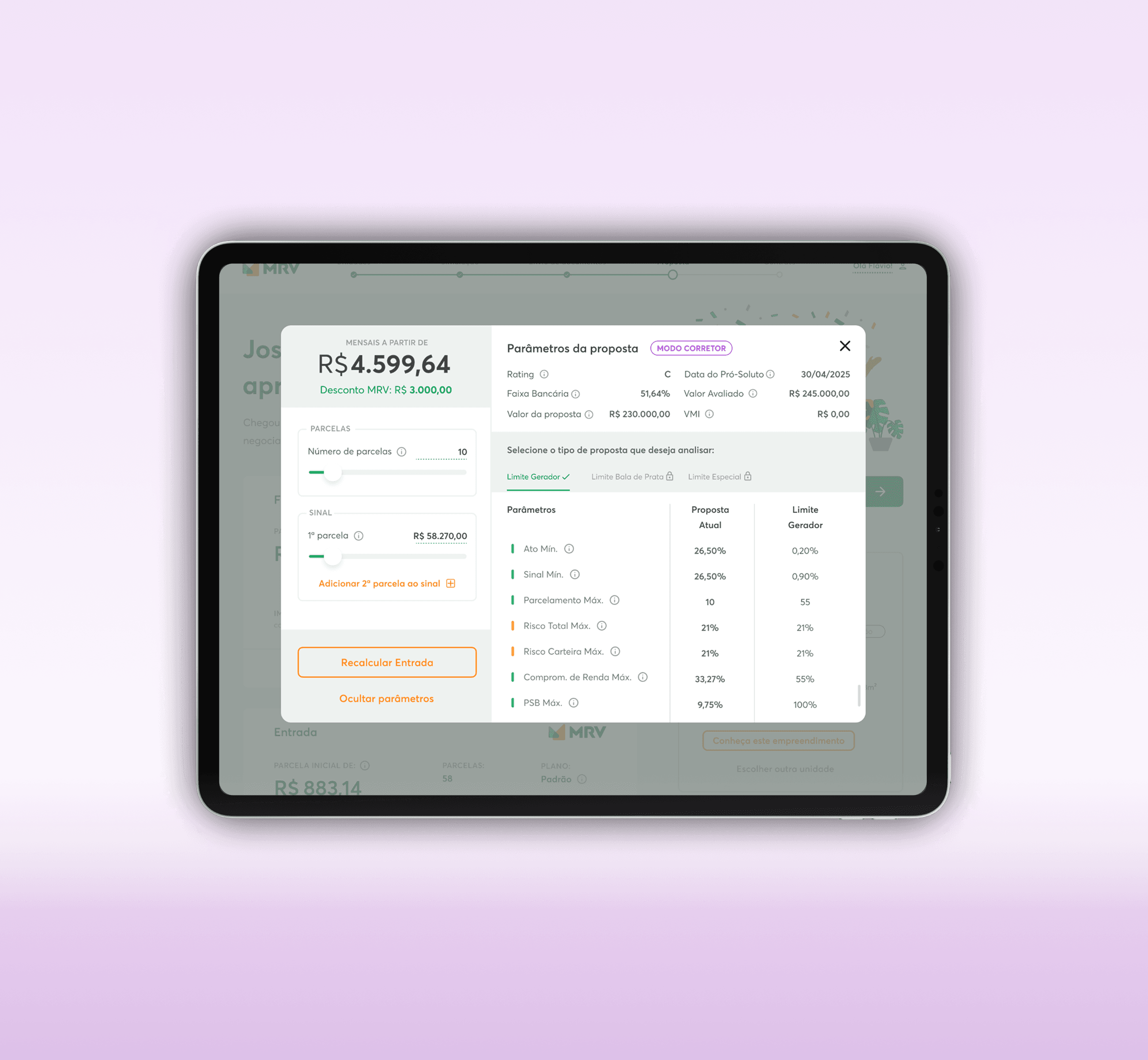
More autonomy in the buying journey.
I generated a 6.6% increase in productivity for brokers and revealed over 60 strategic opportunities for improvement.
Cliente
Pilot Sales Self · MRV & Co
Role
Product Stage:
Growth
Ano
2022
01
Challenge
The experience depended on early data collection and a one-way flow for clients and brokers, limiting exploration of properties and generating sharp declines right from the start. The absence of a user-centric strategy made navigation unintuitive and reduced the perceived value of the platform.
02
Solution
Based on in-depth research and a pilot program with A/B testing, prototypes, and behavioral analysis, I restructured the initial journey focusing on freedom of exploration, visual appeal, and strategic branching of the flow. The new digital storefront, filters, and rich content made choices more emotional, while options like skipping the simulation increased negotiation efficiency.
03
Results
The evolution of the digital gallery and storefront has increased conversion and usage in stores, generating +6.6% productivity for brokers and revealing more than 60 strategic opportunities for improvement. The journey has become more flexible, allowing for more natural choices and strengthening the platform's role as a key player in the negotiation process.
Tradeoffs
Reducing initial friction meant taking controlled risk in the funnel by removing traditional data capture barriers. The decision to bifurcate flows for clients and brokers increased structural complexity, but brought strategic gains in commercial efficiency for the broker and freedom of exploration for the end client.
Overview
With many doubts lingering, it was necessary to define a starting point. To do this, I analyzed every detail of the product in its current state; mapping touchpoints, conducting market research, participating as a mystery shopper, interviewing people, analyzing the conversion funnel and how users interacted with the brand through different channels, such as the website and the bot (MIA).
Benchmarking was also a valuable moment, highlighting similarities, differences, and available opportunities.
The investigation revealed not only UX flaws, but also the absence of a user-centered strategy.
After analysis, opportunities emerged at different stages of the journey, but the critical gap identified in the "Customer Service Waiting Time" and access to the "MRV Customer App" became evident.
Conversions depended almost exclusively on two entry points: the chat button and a registration form, both requiring personal data and marketing consent right from the start.
Data analysis showed that less than half of users completed the process, with a sharp drop-off in the early stages. The main obstacles were the premature request for sensitive information and the lack of freedom to explore the content before committing or realizing the true value of the product.
At the end of the problem understanding phase, three main points became evident:
✋ Early collection of sensitive data
The requirement for information right at the beginning deterred potential clients.
🏠 Lack of freedom to explore properties
Interface with little visual appeal and little information on unit selection.👥 Rigid and undemocratic journey
Clients and brokers, with distinct profiles, were forced to follow the same flow.
The Pilot Project
The next step was to transform the insights into testable hypotheses. We then planned a pilot project, selecting some specific ventures within a defined timeframe.
I was directly involved in defining the experiments and variations tested, writing the hypotheses, creating prototypes, and monitoring performance (via A/B testing and behavioral analysis through recordings).
Here we also took the opportunity to conduct research (surveys via Hotjar) and interviews with users.
Pilot Insights
The pilot was a success, running for only a few days and with just a few businesses, impacting over 700 customers!
More than 60 opportunities for improvement were identified, with hypotheses validated based on real behavior. To help visualize the collected information, I used a Journey Map:
This entire process revealed important insights, especially in the initial stage of Choosing a Project and Unit:
🎭 Balance: A balance is needed between discovery for the client and commercial efficiency for the broker.
👥 Behavioral differences: Brokers preferred to skip the simulation and go straight to credit analysis as a negotiation strategy.
🧭 Navigation: Unintuitive flow, without filters and with a confusing content structure.
👁️ Visual appeal: Unattractive interface and lack of clarity in the presentation of units.
🏡 Content: Users expected a more engaging experience, with images, floor plans, videos, and differentiating features.
"Brokers demonstrated insecurity. They preferred to use their own "non-standardized" materials rather than presenting the MRV Platform page when conducting negotiations with the client."
Strategy and Execution
We conducted an ideation phase through the construction of a User Model (USM), which facilitated the design criteria and helped with prioritization.
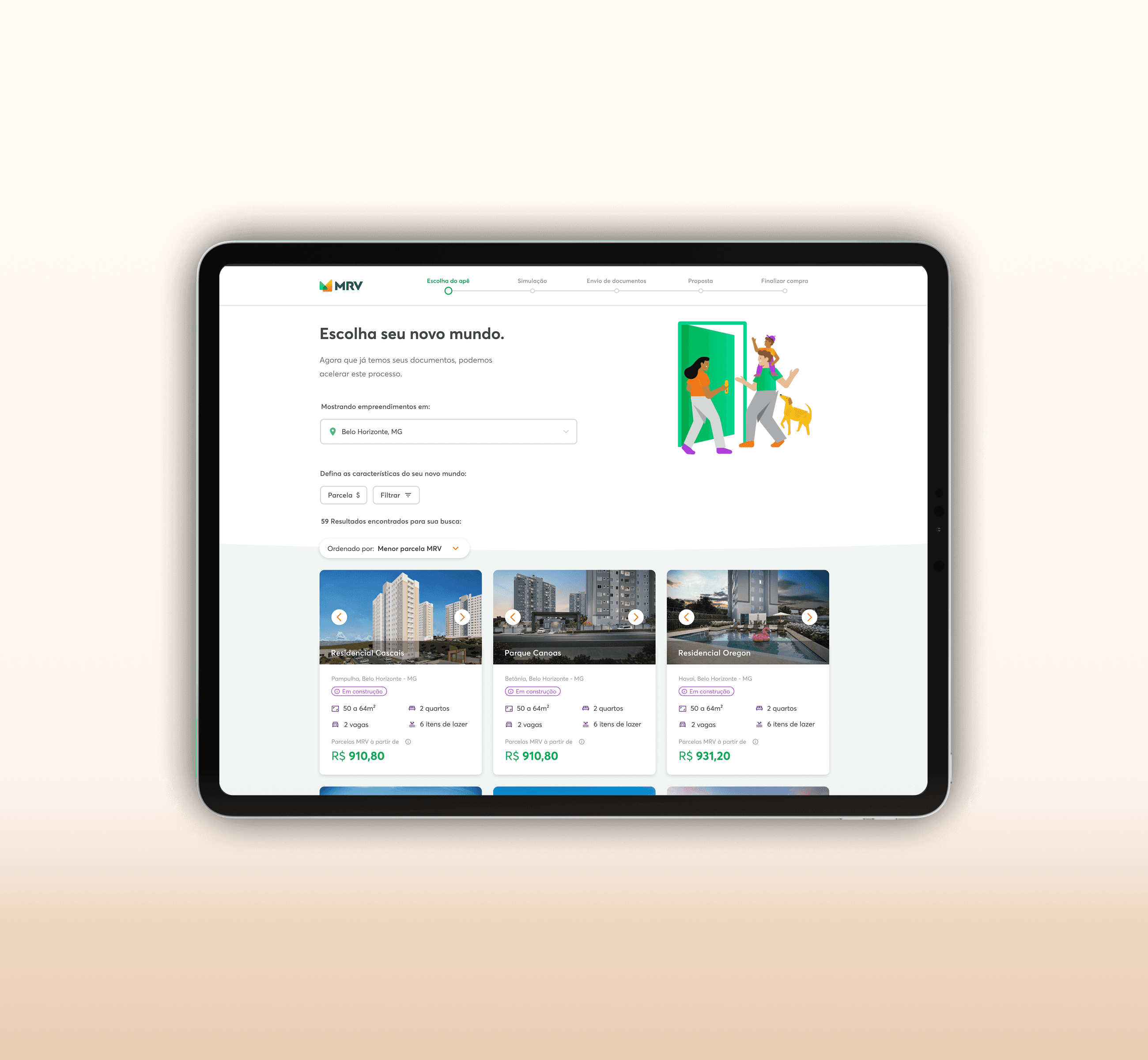
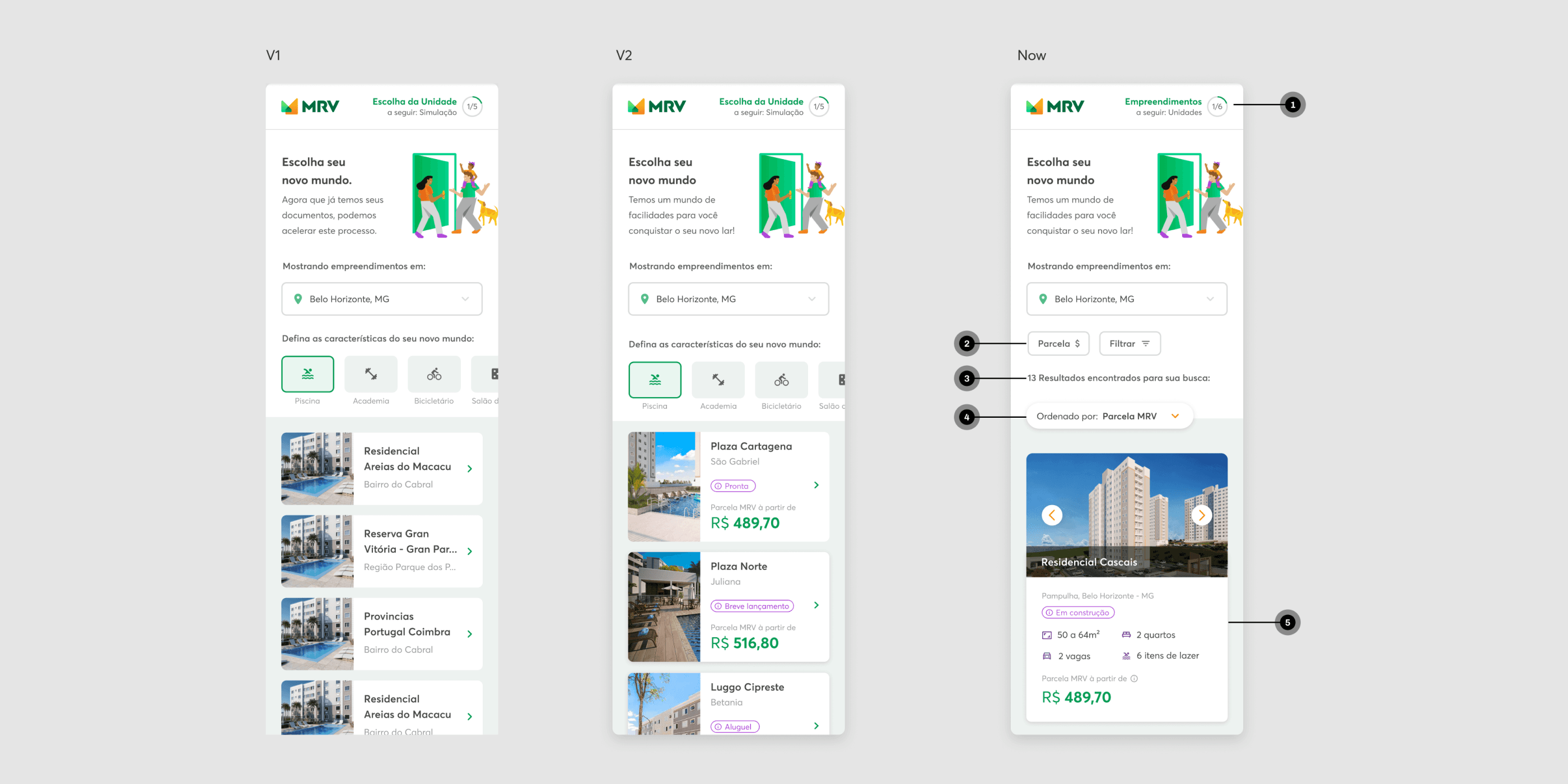
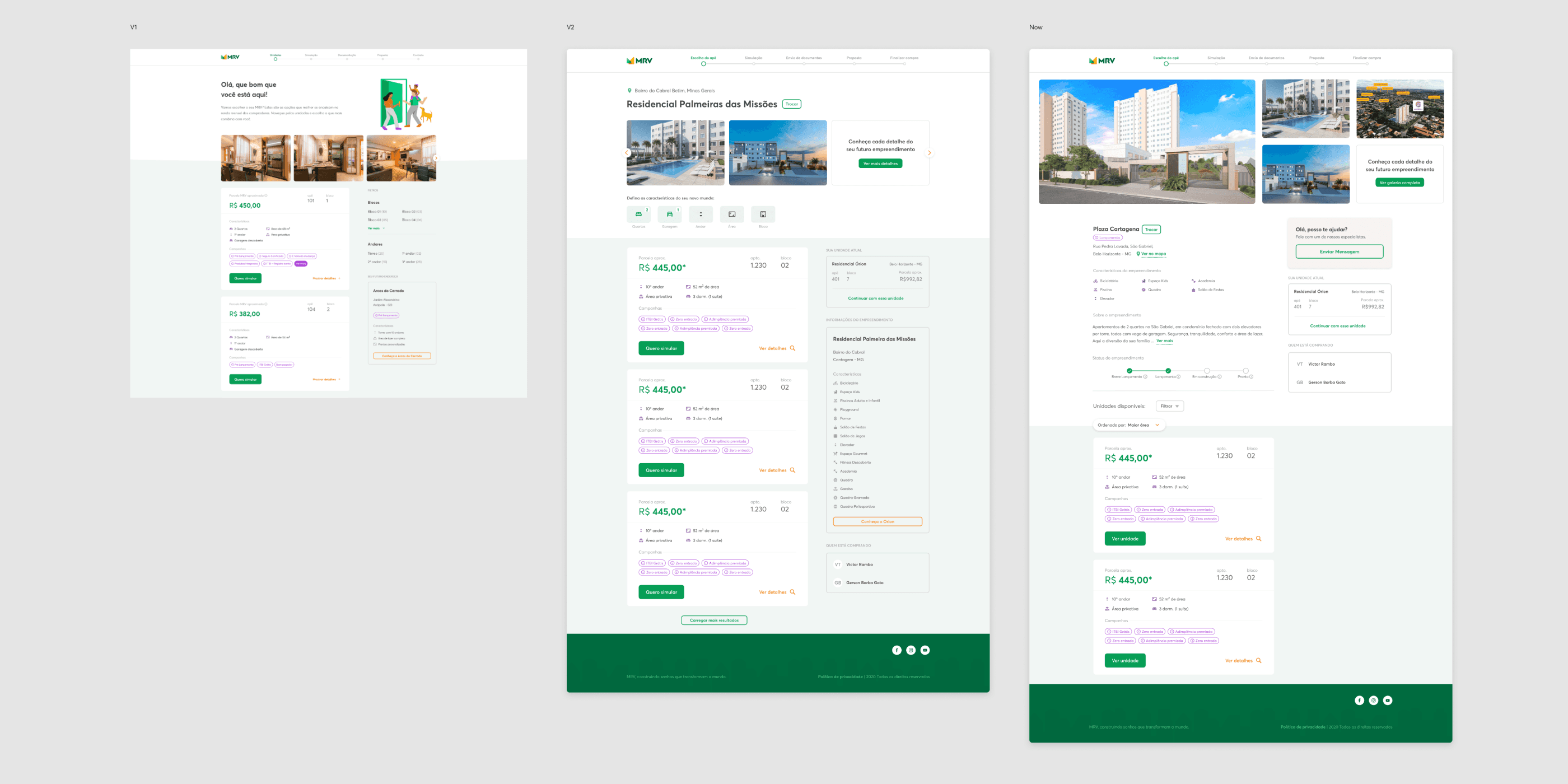
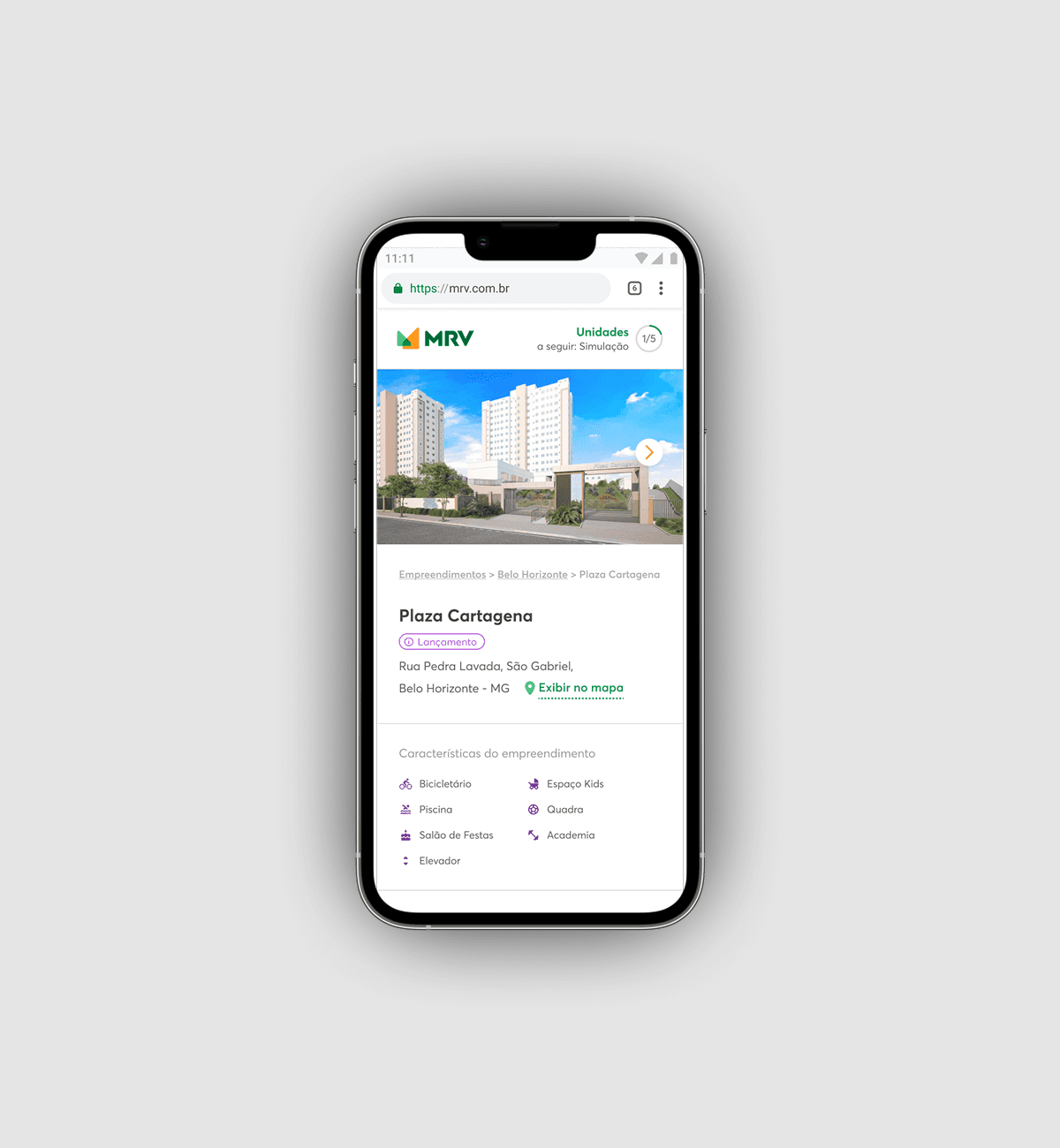
Among the proposed improvements, we can highlight the "showcase," which features larger cards highlighting photos of the properties and displaying the most important information for an initial selection.
We also understand that it should be easy to navigate and organize among the possibilities; therefore, filters and sorting become essential.
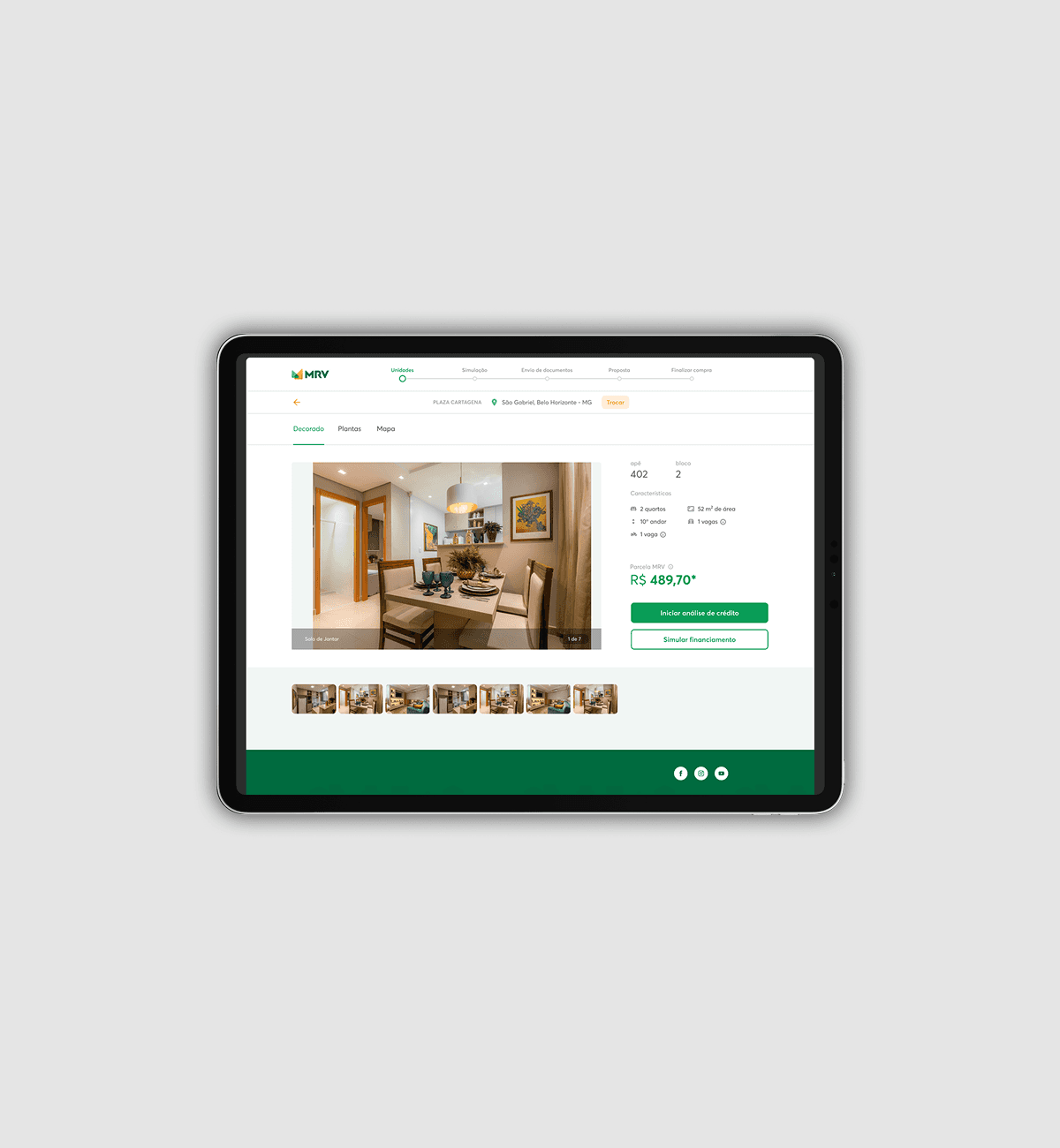
When demonstrating interest and selecting a property, it's important to display what is expected at that moment: detailed and unique information about that unit, such as interior images, floor plans, technical specifications, specific characteristics, and videos.
For the real estate agent, a bifurcation between "Simulate Financing" or "Start Credit Analysis" is essential, allowing the agent to proceed more efficiently.
Results
📈 Increased conversion and usage in stores, with the evolution of the gallery and digital storefront
📈 +6.6% in productivity in the brokers' journey, with the option to skip the simulation
📊 +60 opportunities for improvement mapped in the MRV pilot phase
Some impacts on the business and experience were also observed, changing user behavior:
✅ More freedom to explore information and developments directly on the Platform
✅ More emotional and less procedural choice, with the support of visual content and differentiators
✅ Flexibility in negotiation, making it easier to switch products during the journey
Lessons Learned
Despite the impressive results, it was possible to learn from mistakes and suggest improvements:
📌 Need for personalization: different profiles (clients and brokers) require their own flows
📌 Testing and monitoring must be constant; only then is it possible to evolve